




Thaipoosam Cavadee is the major Tamil celebration in Mauritius, held in January or February at the full moon of the Tamil month of Thai. It honours Muruga, the son of Shiva, and marks the end of 10 days of abstinence and spiritual reflection. Participants carry a flower-covered bamboo arch from a water source to the kovil. Our concierges at Legend Hill, a resort worthy of a prestigious hotel in Mauritius, can guide guests towards the most accessible sites. Here is everything you need to know about the meaning behind the rituals, how the celebration unfolds and the customs visitors should observe.
Thaipoosam Cavadee honours Muruga, the second son of Shiva, who is revered as a deity of war and wisdom. This devotional tradition belongs to the Mauritian Tamil community, whose presence on the island dates back to the 18th century: as early as 1729, traders and craftsmen from southern India were working in Port Louis, long before the wave of indentured labour in the 19th century. Tamil is still one of the languages spoken in Mauritius.
The festival takes place during Thai, the tenth month of the Tamil calendar, at the full moon. It marks the end of a 10-day period of strict fasting: meals prepared at home, without any animal flesh, and nights spent on a simple cloth laid on the floor. The day is one of the public holidays of the Republic of Mauritius; in 2026, it fell on Sunday 1 February.
The word refers to the ritual object that gives the festival its name: a crescent-shaped arch attached to bamboo poles and decorated with foliage, flowers and sacred images. Two pots of milk are suspended from its ends. The bearer carries it on their shoulders, barefoot, all the way to the kovil, the local name for a Tamil temple.
A Tamil legend explains the object itself. The sage Agattiyar asks his disciple Idumban to bring back the peaks of two mountains from Mount Kailash. Idumban ties them to the ends of a carrying pole, the cavadee, and sets off. Carried away by his pride, he challenges Muruga and loses his life, before being brought back among the living. Ever since, carrying the cavadee to the temple earns the devotee the grace of the god, and the gesture teaches humility far more than strength.
The most striking ritual involves vels, fine silver spear-shaped needles that pierce the tongue and cheeks. They represent the vow of silence observed throughout the procession. Some participants also place them on their backs and chests as a sign of penance.
The milk must neither spill nor spoil during the procession, which explains the slow pace and concentration of the participants. Families often prepare the structure the day before, with several generations coming together. The dominant colours, saffron yellow and red, appear both in clothing and floral decorations.
The day begins at around 4 a.m., in the cool early morning air. Participants first gather at the place of worship for the initial prayers before heading to a river or the seashore for a purification bath. This is where the ritual piercings take place and where the structure receives its final decorations.
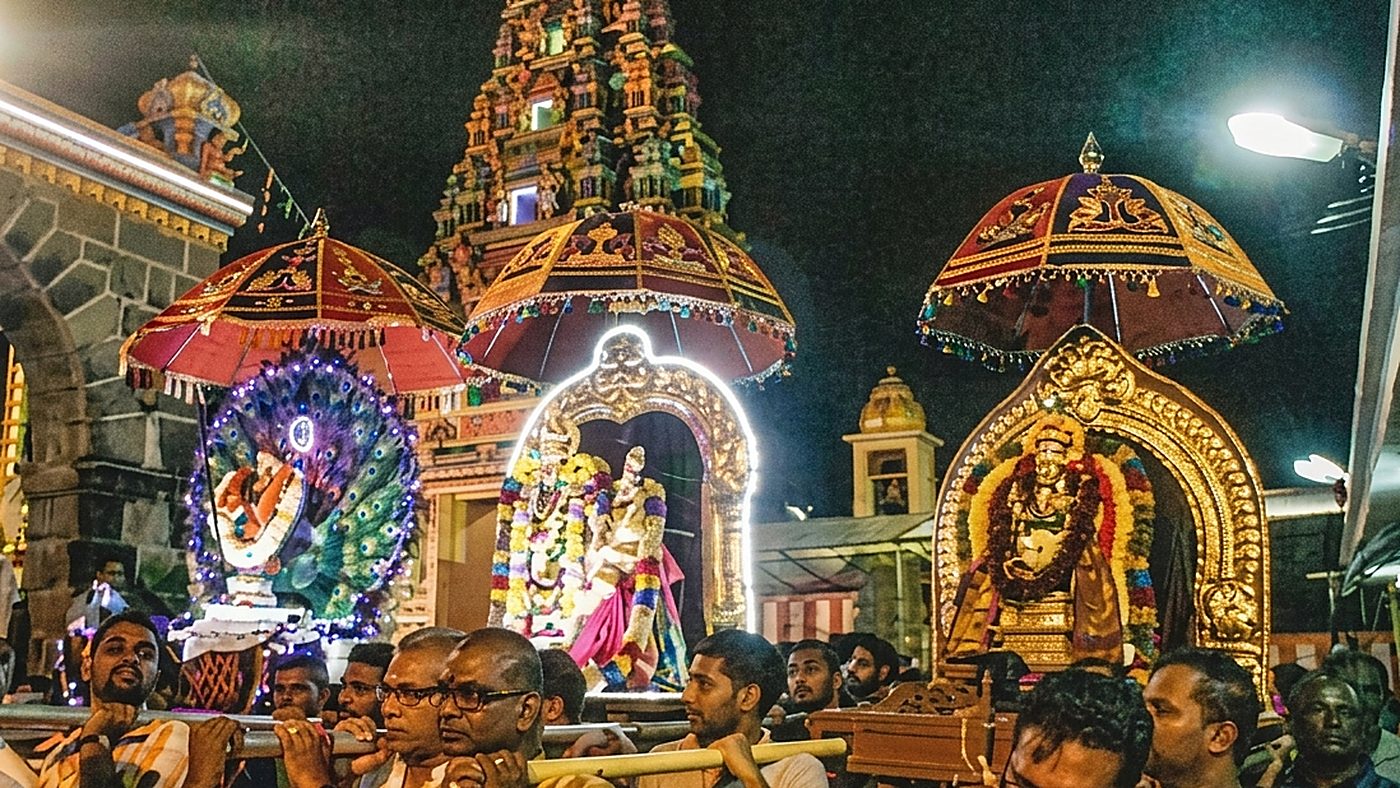
The procession then sets off, accompanied by traditional songs and dances. It moves slowly, sometimes covering several kilometres, amid the sound of drums. Upon arrival, the milk is poured over the image of Muruga, completing the vow. Families then break their fast at home, around a vegetarian meal.
This devotional celebration takes place outdoors and in public spaces, and visitors are generally welcomed warmly. Discretion is nevertheless essential, as this is a deeply personal and spiritual occasion. Before joining a procession, keep the following customs in mind:
This coexistence of religious calendars stems from the history of Mauritius, shaped by successive waves of settlement. From our estate in Rivière Noire, the Legend Hill concierge team can identify accessible sites and arrange transfers in time for the first prayers.
Our guests often leave deeply moved by the silence of the bearers. We recommend arriving early, when the area around the water is still coming to life in the darkness: it is the most powerful moment.
Would you like to discover Mauritius through its traditions rather than simply following the usual tourist guides? Book your stay at Legend Hill in one of our private villas for rent: our concierges can create a cultural itinerary around the island’s major events.
Fancy experiencing a Cavadee at first light?
Method: the public holiday status and the 2026 date were taken from General Notice No. 611 issued by the Prime Minister's Office, the legend of Idumban, the role of the vels and the sequence of the rituals were verified in L’Express de Maurice, the age of the Tamil community was dated by Le Mauricien, and the field customs were supplied by the Legend Hill team, verified in September 2026. The date moves every year: it follows the full moon of the month of Thai, not the Gregorian calendar.
Avi Rumjansing entered Mauritian hospitality in 2002 as a cashier at Indian Resort. Twenty years later, after Les Pavillons, the Mövenpick and fifteen years at Aanari Hotel & Spa as Front Office then Operations Manager, he runs the front desk at Legend Hill. He holds a BSc in Management from the Open University of Mauritius, and he is the one guests ask when to set off for the tea route.